


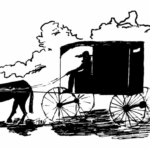


I remember, years ago, when I first heard the word. I was visiting an Amish home and a woman was talking about getting her husband from the buggy. I thought that was odd because I had just passed the buggy and no one was in it. But turns out, I had misheard. She had said ausbund, not husband. They sound similiar. The Ausbund (pronounced "OWS-bound") is the official hymnal of the Amish church and many Mennonite congregations.
With its origins tracing back to 1564, the Ausbund stands as one of the oldest continuously used hymnals in the Christian world. Unlike mainstream Protestant churches that have adopted contemporary worship music, the Amish have preserved this centuries-old songbook as a cornerstone of their spiritual identity. And you can definitely appreciate the soak in the history and mystery of the music if you ever have a chance to attend an Amish church. I don't understand most of the music because it is sung in High German, but that doesn't mean I can't appreciate its beauty.
The name itself reflects its history: "Ausbund" comes from the German word meaning "collection" or "gathering." And the music is history preserved in amber, a direct line to the martyrs and believers who composed its verses under persecution.
A History Rooted in Martyrdom
The Ausbund's story is inseparable from Anabaptist martyrdom. Many of the hymns were written by imprisoned Anabaptists in 16th-century Europe, often composed in dungeon cells awaiting execution. These weren't abstract theological exercises; they were testimonies of faith written by men and women facing death for their beliefs.
The original Ausbund, first published in 1564 at Wolkenstein in Moravia (in present-day Czech Republic), contained 51 hymns. Over the centuries, it expanded, and modern editions contain around 140 hymns. The oldest surviving copy, printed in 1583, is housed in Goshen College's Mennonite Historical Library in Goshen, Indian, a significant archive for anyone researching Amish and Mennonite history.

There was an Amish-Mennonite man in Pennsylvania who wrote a history of the Ausbund, a super book that I still have a copy of buried in a box in my office somewhere. Ah, I found it online, the book is called the Amazing Story of the Ausbund.
The Ausbund in Modern Amish Life
If you've ever attended an Amish church service, you've experienced the Ausbund firsthand. During the typical three-hour Sunday worship (and, yeah, if you don't understand German, that 3-hours can really drag slowly), congregants sing from this hymnal in unison, their voices filling the barn or meetinghouse in slow, deliberate harmony that a photographer friend once described to me as a sort of Gregorian chant.
Several things make Ausbund singing distinctive:
No Musical Accompaniment: Amish tradition forbids instruments in worship. All singing is a cappella, creating the haunting, meditative sound characteristic of Amish worship.
No Written Notes: The Ausbund contains only lyrics and text, no musical notation. Melodies are learned orally, passed down through generations. Young Amish children grow up hearing these tunes at home and in church, absorbing them naturally.
Slow, Sustained Singing: Amish hymn singing is deliberately slow and contemplative—what might take three minutes in an English church takes ten or more in an Amish service. This allows for deep reflection on the lyrics and is what helps make the Amish church services 3 hours!
German Language: The Ausbund is written in German (specifically Pennsylvania Dutch/Deitsch), reinforcing the cultural and spiritual identity of the community.
Notable Hymns from the Ausbund
The Ausbund contains both well-known hymns and obscure ones. Some of the most frequently sung include:
- "Gott segne dich" ("God Bless You") – A blessing often sung as a closing hymn
- "Das Lob Gottes" ("The Praise of God") – A hymn celebrating divine majesty
- "O Gott, Vater, wir loben dich" ("O God, Father, We Praise Thee") – A traditional opening hymn
- "Wie selig sind die Frommen" ("How Blessed Are the Righteous") – Often sung at funerals
Each hymn tells a story—of faith, endurance, redemption, or the martyrs' journey.
The Ausbund and Amish Identity
For the Amish, the Ausbund is far more than a songbook. It's a symbol of their commitment to Gelassenheit (yielding to God's will), their separation from the outside world, and their continuity with their ancestors. Using a 500-year-old hymnal, unchanged in its core contents, expresses a profound theological statement: we are part of an unbroken chain of faith.
Variations Across Amish Communities
Not all Amish groups use the identical Ausbund. Some communities have slightly different editions or may emphasize different hymns. Conservative communities in eastern Pennsylvania, Ohio, Indiana, and Kentucky each have their particular traditions. For this, I am going more by what I have been told, because, well, when I have attended church I can't understand what is being said. Now someone visiting from Germany might still have difficult because the Amish German has evolved, but they would have a far easier time.
Some progressive Amish communities, particularly in newer settlements or areas with more outside influence, may incorporate a few additional hymns, though the core Ausbund remains central.
Finding the Ausbund
If you're interested in exploring the Ausbund yourself, several options exist:
- Purchase a physical copy: English translations are available, though reading the original German alongside offers richer context.
- Listen to recordings: Various Amish and Mennonite musicians have recorded Ausbund hymns, providing audio of the traditional melodies.
- Visit Amish communities: Attending a Sunday service (where visitors are welcome in most communities) offers an authentic experience of Ausbund singing.
- Academic resources: Libraries and Mennonite colleges maintain historical collections and scholarly articles on the Ausbund's origins and significance.
The Ausbund in a Changing World
As Amish communities navigate modernity—with decisions about technology, education, and economic participation—the Ausbund remains a stabilizing spiritual anchor. In a world of constant change, singing the same hymns their ancestors sang provides continuity, comfort, and communal identity.
The Ausbund represents more than religious practice; it's a living connection to history, a voice of faith across five centuries, and a unique expression of what it means to be Amish.
I found some snapshots I took probably back in the mid-90s.
The first photo below is of the "church bench wagon" parked outside of Elizabeth's home. The church bench wagon moves from place to place wherever services will be held next. This church bench wagon is black, but I have seen them colored white in some Amish settlements and gray in others. The wagon contains the church benches, the songbooks, and maybe a lost and found box for those bonnets or gloves inadvertently left behind. Ha, here's a funny story: cell phones are allowed in some Amish churches, not allowed in others, and in many places they are tolerated or sort of allowed for business, but not home-use. I know of an Amish family that once held church in their home and after services and everyone had gone home they found a cell phone underneath one of the benches. Since the battery was dead, the founders couldn't determine who it belonged to. Of course no one ever came to claim it because they really weren't supposed to have cells in this particular district. .
The next photo is a closer-up shot of inside the bench wagon at a church songbook (known as the Ausbund). The songbooks are stored in heavy wooden boxes. At the time I took these photos, back in the mid-90s, they stirred a little controversy within the church, which viewed them as a bit intrusive (I had been given permission to photograph them). I think today they'd barely cause a blink. How times have changed.
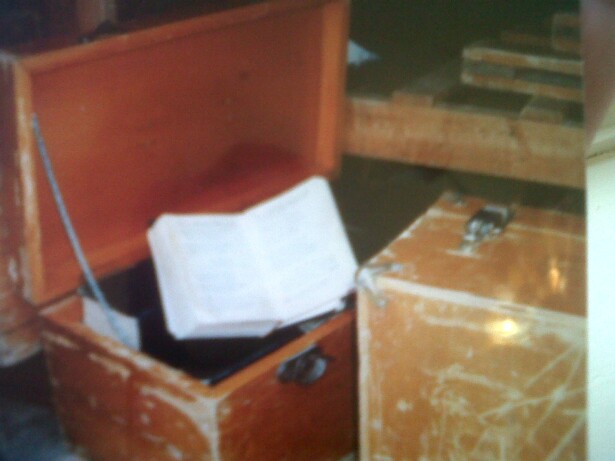
The photo is pretty blurry, but you get an idea of how the books were, and probably still are, stored away in heavy wooden boxes to protect them.





Nancy
I watched the video of your grandmother and uncle. They are so sweet. I got the portions for the penut butter but was it the raw ground penut butter or the homogenized that we get and then mix the marshmellow fluff and corn syrup. Can we have the receipe for the snack with the rhubarb on it?
Thanks so much, love your blog.
Kevin
Nancy, welcome..thanks for stopping by from the Great North...where in Canada are you?:) And the recipe for Amish church peanut butter spread is: 1 /3 parts corn syrup, 1 /3 parts regular peanut butter...just like a jar of regular pb from the store..Jif, Skippy, Etc and 1 /3 part marshmallow fluff...You can really adjust the proportions of each to fit your taste..some like it thicker...I like mine a little runner so I go heavier on the corn syrup...easiest recipe in the world:) And I'll try to dig up a rhubarb jam recipe for you! Thanks again for coming here!
Sugar Maple Gal
I also was an Elizabeth fan. I read her interesting column every Wednesday in our local paper. I cut out quite a few of her recipes (which I still have in my collection) I shared your heatbreak when she passed. I'm glad her daughter carries on the tradition. The Amish are indeed a very special breed.
Kevin
Welcome Sugar Maple, which Wednesday paper did you read the column in?
Sugar Maple Gal
It was the Somerset Daily American published in Somerset, Pennsylvania. Since I am now retired, I read the paper at work, I don't have access to it anymore.
Dorothy Shaulis
I too read the Amish Cook column in the Somerset Daily American. I always look forward to Wednesdays, as that is when it is in the paper. Your grandma and uncle are cute. They certainly don't look their age! I also was a fan of Elizabeth and love hearing all about Lovina and her family. I have a couple of the hard back books and I enjoy them. There are Amish living all around here, near Shanksville and Brotherton. They usually go down past our house on 160 in their buggies Sunday afternoon.
Sharon
I recently found your site here and went to the videos you have on the Amish. I think it was a done in 2009 on BBC . I liked it and it answered a lot of my questions about there believes I am grateful for all the information that you have provided . thanks